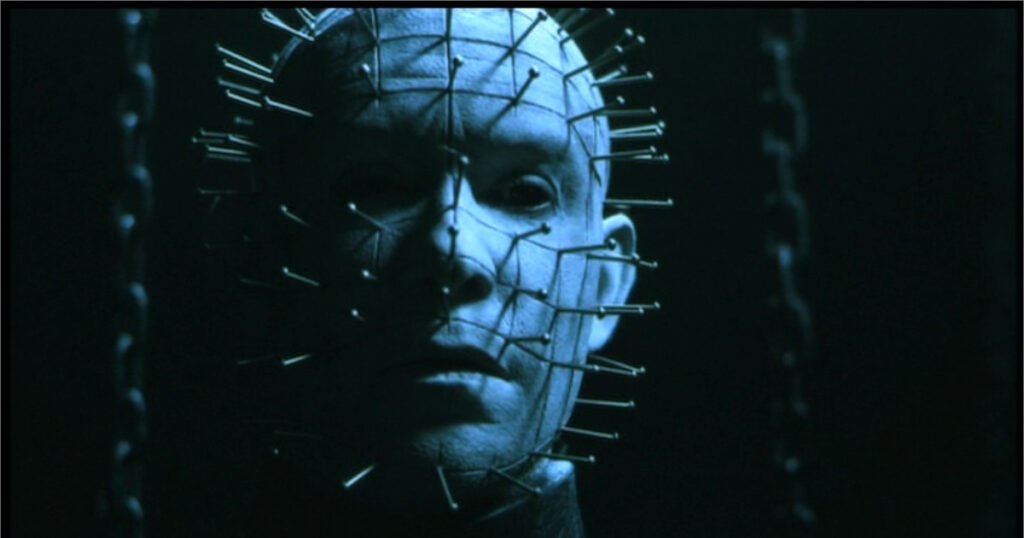
Hellraiser: Hellseeker (2002) Review – Kirsty Returns in a Dark, Psychological Sequel
Title:
Hellraiser: Hellseeker (2002)
Writer(s):
Clive Barker (characters), Carl V. Dupré, Tim Day
Director:
Rick Bota
Main Cast: Actor (Character):
Dean Winters (Trevor Gooden), Ashley Laurence (Kirsty Cotton), Doug Bradley (Pinhead), Rachel Hayward (Allison), Sarah-Jane Redmond (Gwen)
Synopsis
Hellraiser: Hellseeker (2002) returns the franchise to familiar territory with the reappearance of Kirsty Cotton, though the film primarily follows Trevor Gooden, a man who survives a tragic car crash in which his wife, Kirsty, disappears. As Trevor attempts to piece together the events leading up to the accident, he experiences vivid hallucinations, disturbing encounters, and gaps in memory that leave him questioning his sanity. The police suspect him, reality fractures around him, and the Lament Configuration once again promises answers, at a dire cost.
The film blends psychological mystery with supernatural horror, slowly drawing Trevor toward a confrontation with Pinhead and his buried secrets.
What Works
The return of Ashley Laurence as Kirsty is a highlight, providing a welcome link to the original films and giving long-time fans a reason to re-engage with the story.
The psychological approach, similar to Hellraiser: Inferno, works well when the film leans into paranoia, guilt, and the sense of being trapped in one’s own mind. Trevor’s unreliable perspective adds tension and keeps the viewer guessing.
Doug Bradley remains excellent as Pinhead, delivering cool, judicial menace even in limited screen time. His presence gives the film gravitas.
The final twist is one of the film’s strongest elements, recontextualising the narrative and giving more weight to Kirsty’s involvement.
What Doesn’t Work
Much like its predecessor, Hellseeker suffers from the “script retrofit” problem, feeling more like a standalone psychological thriller that the studio moulded into a Hellraiser sequel. As a result, the Cenobites are underused and the tone feels disconnected from Barker’s original vision.
The pacing can be uneven, with repetitive dream sequences and hallucinations that make the middle stretch feel bloated.
Fans expecting a Kirsty-centred story may be disappointed, as her role is minimal until the final reveal.
Budget limitations also show in creature design and effects, leaving some Cenobite moments feeling less impactful than earlier films.
Final Thoughts: Does It Hold Up?
Hellraiser: Hellseeker holds up better than some of the later sequels, largely thanks to Ashley Laurence’s return and a satisfying twist that ties the story back to the original mythology. While it suffers from structural issues and a lack of iconic Hellraiser imagery, it remains a decent psychological horror entry, especially when viewed as a companion piece to Inferno.
For long-time fans, its connection to Kirsty adds emotional weight that elevates it above the weakest instalments.
Who Would Enjoy This Episode?
- Fans of psychological and mystery-driven horror.
- Viewers who enjoyed Hellraiser: Inferno’s tone and structure.
- Long-time fans interested in Kirsty Cotton’s fate.
- Those who prefer character-driven horror over creature spectacle.
Who Might Not Enjoy It?
- Fans wanting frequent Cenobite action or continuity-heavy storytelling.
- Viewers frustrated by dreamlike or fragmented narratives.
- Those expecting high-budget effects or classic Hellraiser body horror.
Final Verdict
Hellraiser: Hellseeker (2002) is a moody, twist-driven sequel that mixes psychological dread with familiar franchise elements. Imperfect but engaging, it offers a compelling extension to the Kirsty storyline and stands as one of the stronger direct-to-video entries.