Sapphire & Steel: Assignment Four (Season 4)
Sapphire & Steel: Assignment Four (Season 4)
Plot Summary
Assignment Four is often regarded as the defining story of Sapphire & Steel, and it is not difficult to see why. Set almost entirely within an abandoned railway station, the episode constructs a world that feels detached from time itself. There are no crowds, no movement, no sense of normal function. Instead, the station exists in a kind of suspended state, as though it has been forgotten by reality.
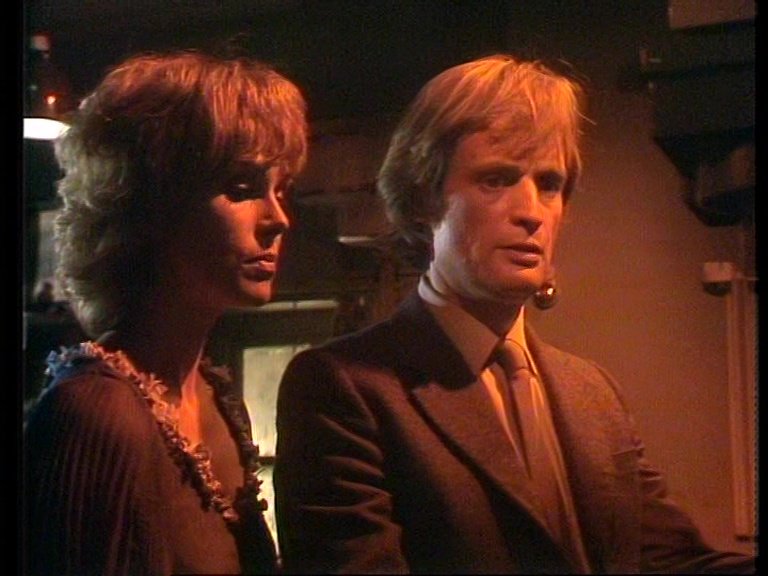
Sapphire and Steel arrive to investigate yet another temporal disturbance, but the nature of this one is immediately more oppressive. Figures appear within the station, dressed in period clothing from different eras, yet crucially, they have no faces. These entities move slowly and deliberately, occupying the space without interacting in any recognisable human way.
The threat is not overtly aggressive at first. Instead, it is defined by presence. The faceless figures exist as manifestations of something wrong within time, echoes or imprints that have lost their identity. As Sapphire and Steel attempt to understand the disturbance, it becomes clear that the station itself is a trap, a place where time has stagnated and begun to decay.
Movement becomes dangerous. Interaction becomes unpredictable. The agents find themselves increasingly constrained, both physically and conceptually. The usual methods of containment prove less effective, as the environment itself resists their control.
The resolution, if it can be called that, offers little comfort. The disturbance is addressed, but not in a way that restores normality. Instead, the sense remains that the station exists outside the usual rules, a place where time has broken down beyond easy repair. Sapphire and Steel leave, but the unease lingers, suggesting that some breaches cannot be fully sealed.
Deeper Analysis
Assignment Four represents the series at its most distilled. It strips away even more of the already minimal framework, focusing almost entirely on atmosphere, space, and presence. The railway station is no longer simply a setting, but a character in its own right, shaping the narrative through its emptiness and stillness.
The faceless figures are central to the episode’s impact. By removing identity, the story removes empathy. These are not ghosts in the traditional sense, nor are they recognisable entities. They are fragments, remnants of time that have lost their defining features. This absence is what makes them so unsettling. The human form is preserved, but the individuality is gone.
This concept ties into the series’ broader themes of time and memory. Identity is closely linked to both. When time breaks down, so too does the continuity that allows identity to exist. The faceless figures can be seen as the result of this breakdown, people reduced to outlines, stripped of the details that make them human.
The station itself reinforces this idea. It is a place designed for movement and transition, yet here it is static. Trains do not arrive or depart. Passengers do not pass through. The very purpose of the location is undermined, creating a sense of dissonance. This tension between intended function and actual state is a key source of unease.
Sapphire and Steel’s roles are tested in new ways. Their usual authority is diminished by the environment. Steel’s emphasis on control becomes less effective in a space that does not respond to normal rules. Sapphire’s interpretive approach offers more insight, but even she struggles to fully comprehend the nature of the disturbance.
This shift highlights a crucial aspect of the series. The agents are powerful, but not omnipotent. There are limits to their understanding and their ability to impose order. Assignment Four brings those limits into focus, creating a sense of vulnerability that is largely absent from earlier stories.
The pacing is particularly notable. Scenes unfold slowly, often with minimal dialogue. The camera lingers on empty spaces, allowing the viewer to absorb the atmosphere. This deliberate approach may feel unconventional, but it is essential to the episode’s effect. The horror is not driven by action, but by anticipation and presence.
Sound design plays a crucial role once again. The absence of noise is as important as its presence. Footsteps echo unnaturally. Silence stretches longer than expected. These elements contribute to the sense that the station exists outside normal reality.
Production limitations are used to remarkable effect. The sparse set design, combined with careful lighting, creates a visual style that feels both minimal and evocative. The lack of elaborate effects forces the focus onto composition and movement, enhancing the overall atmosphere.
Another important aspect is the episode’s refusal to provide clear answers. The nature of the disturbance is never fully explained. The origins of the faceless figures remain ambiguous. This lack of resolution is not a weakness, but a deliberate choice that reinforces the series’ themes.
Highlights
- The iconic faceless figures, both simple and deeply unsettling.
- A masterful use of setting to create atmosphere and tension.
- The exploration of identity and its connection to time.
- A deliberate pacing that allows unease to build gradually.
- Strong visual composition despite minimal resources.
What Doesn’t Work:
- The slow pacing may test the patience of some viewers.
- The abstract nature of the threat can be difficult to interpret.
- Limited character interaction reduces emotional engagement.
- The lack of resolution may feel unsatisfying to those expecting closure.
Final Thoughts
Assignment Four is widely regarded as the high point of Sapphire & Steel, and with good reason. It captures everything that makes the series distinctive, its commitment to atmosphere, its reliance on suggestion, and its willingness to embrace ambiguity.
The episode demonstrates how effective minimalism can be when combined with strong conceptual ideas. By stripping away unnecessary elements, it focuses the viewer’s attention on what truly matters, space, presence, and the unsettling implications of a world where time can break down.
While it may not offer the satisfaction of a traditional narrative, it provides something far more enduring. A sense of unease that lingers long after the episode ends. In doing so, it cements its place as one of the most memorable and influential pieces of British science fiction horror.