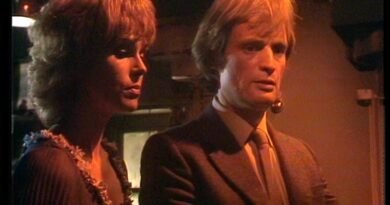
Sapphire & Steel: Assignment Two (Season 2)
Sapphire & Steel: Assignment Two (Season 2)
Plot Summary
Assignment Two shifts the focus of Sapphire & Steel away from domestic unease and into a more public yet equally isolated setting, a railway station suspended somewhere between past and present. The story begins with the appearance of a First World War soldier, disoriented and clearly out of place, as though he has stepped directly out of history and into the modern world. This intrusion is not treated as a miracle, but as a symptom of something deeply wrong.
Sapphire and Steel are called to investigate, arriving with the same quiet authority that defined their introduction. Once again, they offer no real explanation to those around them, instead imposing order through presence alone. The station itself quickly reveals its true nature. It is not merely a location, but a nexus, a point where time has folded in on itself, allowing fragments of the past to bleed into the present.
As the assignment unfolds, more figures from different periods begin to appear. Each carries with them a sense of displacement, trapped in a loop they do not understand. The soldier becomes the emotional centre of the narrative, representing a past that refuses to remain contained. His confusion and fear stand in stark contrast to the agents’ detachment.
The investigation reveals that the disturbance is not random. Time is repeating, looping back on itself in a way that traps individuals within specific moments. The station becomes a kind of holding area, a place where history is unable to progress. Sapphire attempts to understand the pattern, while Steel focuses on containment, enforcing boundaries even when the consequences are severe.
The resolution is bleak in its efficiency. The loop is broken, the intrusion is contained, but not everyone is saved. The soldier, and others like him, are effectively erased or returned to their original points in time, their suffering unresolved. As always, normality is restored, but the cost is quietly acknowledged rather than celebrated.
Deeper Analysis
Assignment Two expands the thematic scope of Sapphire & Steel while maintaining its commitment to ambiguity and restraint. Where the first assignment focused on the domestic and the familiar, this story moves into a more symbolic space. The railway station functions not just as a setting, but as a metaphor for transition, a place where journeys begin and end, and where movement through time is expected. By disrupting this function, the episode creates a powerful sense of unease.
The presence of the First World War soldier is particularly significant. He represents a moment in history defined by trauma, loss, and unresolved tension. His sudden appearance in the present suggests that time has not properly processed this event, that it lingers beneath the surface, capable of resurfacing under the right conditions. This aligns with one of the series’ central ideas, that time is not a stable, linear progression, but something fragile and susceptible to disruption.
The use of a railway station reinforces this concept. Trains, schedules, and platforms are all symbols of order and progression, systems designed to move people efficiently from one point to another. When time begins to loop within this environment, the effect is deeply disorienting. The expected flow is interrupted, creating a sense of stagnation that contrasts sharply with the station’s intended purpose.
This tension between movement and stasis is key to the episode’s atmosphere. Characters are caught in cycles, repeating actions and conversations without realising it. The audience, however, becomes increasingly aware of the pattern, creating a sense of dramatic irony. This repetition mirrors the structure of memory itself, reinforcing the idea that the disturbance is rooted in the persistence of the past.
Sapphire and Steel’s roles become more defined in this assignment. Sapphire continues to act as the interpretive force, attempting to understand the nature of the disturbance and its underlying logic. Her approach suggests a level of curiosity, even empathy, though it is expressed in a restrained and alien manner. Steel, on the other hand, embodies control and enforcement. He is less concerned with understanding and more focused on restoring order, regardless of the human cost.
This dynamic raises important questions about the nature of their mission. Are they protectors of humanity, or simply agents maintaining a system that operates beyond human concerns? The episode does not provide an answer, but it encourages the viewer to consider the implications of their actions.
The soldier’s role is central to this exploration. Unlike the agents, he is deeply human, defined by emotion and experience. His confusion and fear highlight the emotional impact of the disturbance, grounding the story in a way that contrasts with the agents’ detachment. His eventual fate, ambiguous and unresolved, reinforces the series’ willingness to prioritise concept over comfort.
The episode also makes effective use of sound and silence. The ambient noise of the station, footsteps, distant announcements, the hum of unseen machinery, creates a sense of presence even when little is happening visually. Silence, when it occurs, feels unnatural, heightening the tension. This careful use of audio contributes significantly to the overall atmosphere.
Production limitations once again play a crucial role. The confined setting, minimal cast, and lack of elaborate effects force the story to rely on suggestion rather than spectacle. This restraint enhances the sense of isolation, making the station feel disconnected from the outside world. It becomes a self-contained environment where normal rules no longer apply.
Another notable aspect is the episode’s pacing. Like Assignment One, it unfolds slowly, allowing the situation to develop organically. This measured approach may challenge viewers expecting more immediate action, but it is essential to the story’s impact. The horror emerges gradually, building through repetition and realisation rather than sudden shocks.
The lack of explicit explanation remains a defining feature. The audience is given just enough information to understand the stakes, but not enough to fully comprehend the mechanics of the disturbance. This ambiguity is central to the show’s identity, encouraging interpretation and discussion.
Highlights
- The use of a railway station as a symbolic and atmospheric setting.
- The First World War soldier as an emotional anchor within an otherwise detached narrative.
- The exploration of time loops and repetition as a source of horror.
- Strong use of sound design to create tension and presence.
- The deepening of Sapphire and Steel’s dynamic and methods.
What Doesn’t Work:
- The slow pacing may feel drawn out for some viewers.
- Limited character development outside the central figures.
- The ambiguity, while effective, may be frustrating for those seeking clear answers.
- The resolution, though thematically consistent, offers little emotional closure.
Final Thoughts
Assignment Two builds on the foundation established by the first story, expanding both the scale and the thematic depth of Sapphire & Steel. It demonstrates the series’ ability to take a simple concept and explore it through atmosphere, symbolism, and restraint.
The episode’s strength lies in its willingness to embrace ambiguity. It does not attempt to explain everything, nor does it provide a neat resolution. Instead, it presents a scenario that feels both self-contained and part of a larger, unseen conflict.
The railway station setting, combined with the presence of the soldier, creates a powerful sense of unease rooted in history and memory. It is a story that lingers, not because of what it shows, but because of what it suggests.
In many ways, Assignment Two represents Sapphire & Steel at its most evocative. It balances concept and atmosphere with precision, offering a viewing experience that is as unsettling as it is compelling.