Hellraiser Films Ranked: Box Office, Reviews and Legacy
The Hellraiser Series: Audience Reception, Financial Success and Franchise Decline
The Hellraiser franchise occupies a distinctive place in horror cinema. Emerging from Clive Barker’s novella The Hellbound Heart, the series began as a daring fusion of body horror, dark fantasy and taboo-breaking sexuality. Over the decades, it evolved into a long-running franchise that illustrates both the power and the pitfalls of cult horror filmmaking.
Hellraiser Film Series Financial and Audience Data
| Movie | Year | IMDb Score | Budget | Gross | Return Before Marketing | ROI |
|---|---|---|---|---|---|---|
| Hellraiser | 1987 | 7.0 | $1,000,000 | $14,564,027 | $13,564,027 | 1356% |
| Hellbound: Hellraiser II | 1988 | 6.4 | $3,000,000 | $12,090,735 | $9,090,735 | 303% |
| Hellraiser III: Hell on Earth | 1992 | 5.5 | $5,000,000 | $12,534,961 | $7,534,961 | 151% |
| Hellraiser: Bloodline | 1996 | 5.1 | $4,000,000 | $9,336,886 | $5,336,886 | 133% |
| Hellraiser: Inferno | 2000 | 5.4 | $2,000,000 | N/A | N/A | N/A |
| Hellraiser: Hellseeker | 2002 | 4.9 | $3,000,000 | N/A | N/A | N/A |
| Hellraiser: Deader | 2005 | 4.4 | $2,000,000 | N/A | N/A | N/A |
| Hellraiser: Hellworld | 2005 | 4.2 | $3,000,000 | N/A | N/A | N/A |
| Hellraiser: Revelations | 2011 | 2.7 | $350,000 | N/A | N/A | N/A |
| Hellraiser: Judgement | 2018 | 4.3 | $350,000 | N/A | N/A | N/A |
| Hellraiser (2022) | 2022 | 5.9 | N/A | N/A | N/A | N/A |
Best Audience Reception
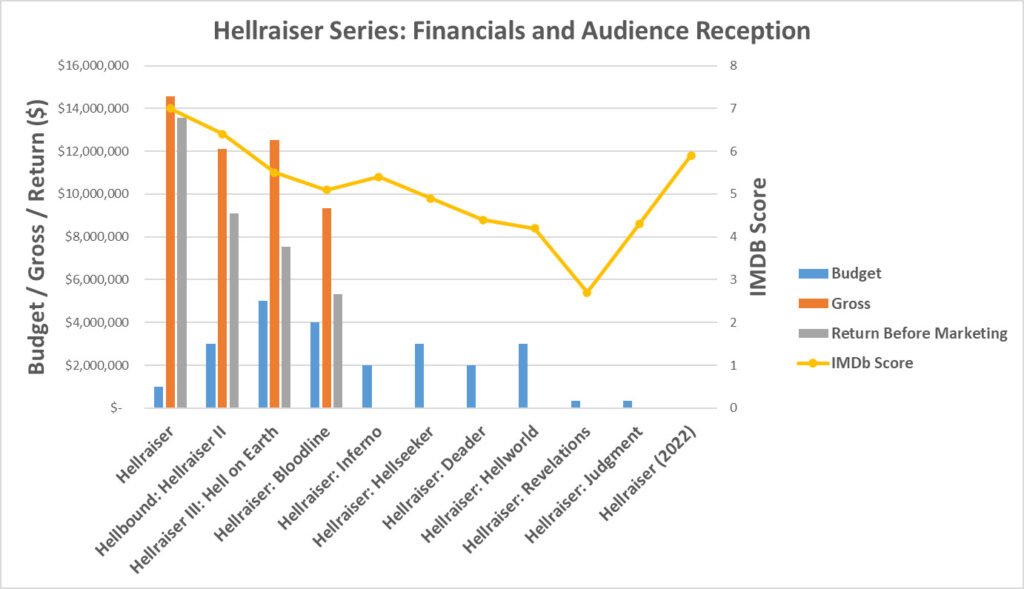
The original Hellraiser from 1987 remains the most highly regarded entry in the series. With an IMDb score of 7.0, it comfortably surpasses every sequel. Its enduring reputation is rooted in Barker’s uncompromising vision, the film’s oppressive atmosphere, and Doug Bradley’s unforgettable performance as Pinhead. Rather than relying on cheap shocks, the film unsettled audiences through implication, philosophy and grotesque imagery.
Hellbound: Hellraiser II is widely considered the strongest sequel. While it lacks some of the narrative restraint of the original, it expands the mythology of the Cenobites and the Labyrinth in bold ways. Its 6.4 rating reflects sustained fan appreciation, particularly among viewers who enjoy deeper world building and more explicit surreal horror.
Among the later entries, Hellraiser: Inferno stands out as a relative high point. Despite being a direct to video release, its psychological and noir influenced structure resonated with some fans, resulting in a higher audience score than most of its contemporaries.
Best Financial Performance
From a financial perspective, the first Hellraiser is the franchise’s greatest success by a considerable margin. Produced on a modest $1 million budget, it earned over $14.5 million theatrically, delivering an exceptional return on investment of approximately 1356 percent before marketing costs. This success helped establish Hellraiser as a bankable horror property.
Hellbound: Hellraiser II also performed strongly, tripling its production budget at the box office. Although Hellraiser III: Hell on Earth earned a slightly higher gross, its increased budget reduced its overall profitability in percentage terms.
Hellraiser: Bloodline marked the end of the franchise’s theatrical run. While it still generated a profit, behind the scenes conflicts and heavy studio interference undermined its impact and curtailed the series’ box office momentum.
The Direct to Video Era
Beginning with Hellraiser: Inferno in 2000, the franchise shifted almost entirely to direct to video releases. These films were produced with smaller budgets and tighter schedules, often repurposing unrelated scripts to meet contractual obligations. As a result, consistency and thematic depth suffered.
Audience reception steadily declined during this period, reaching its lowest point with Hellraiser: Revelations in 2011. Widely criticised for its rushed production and lack of atmosphere, it remains the most poorly received film in the series.
The 2022 Reboot
The 2022 reboot represented a conscious attempt to course correct the franchise. Released exclusively via streaming, it avoided traditional box office measurement but achieved a noticeably stronger audience response than most post 1996 entries. With a 5.9 IMDb score, it benefited from modern production values, a reimagined Cenobite aesthetic, and a renewed focus on Barker’s core themes of desire and consequence.
Conclusion
The Hellraiser series demonstrates how a powerful concept can endure despite uneven execution. Critically and financially, the franchise peaked early, with the first two films remaining the definitive entries. Later instalments kept the brand alive but gradually eroded its reputation. Even so, Hellraiser’s imagery, mythology and philosophical horror ensure its lasting influence within the genre, securing its place as one of horror cinema’s most distinctive and enduring franchises.