Sapphire & Steel: Assignment Five (Season 5)
Sapphire & Steel: Assignment Five (Season 5)
Plot Summary
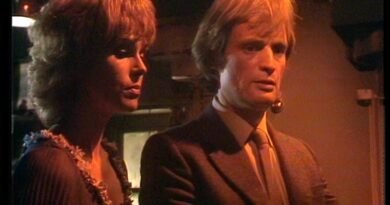
Assignment Five sees Sapphire & Steel move away from purely spatial or psychological disturbances and into something more technological, though in the series’ typically abstract way. The story centres around a modern office environment, where a time breach is linked to the use of communication systems, specifically typing, recording, and transmitting information.
At first, the disturbance appears subtle. Messages begin to appear where they should not. Typed documents contain words that no one recalls writing. Recorded audio includes voices that were never present. The intrusion is not immediate or violent, but it is persistent, gradually eroding trust in the reliability of communication.
Sapphire and Steel arrive and quickly identify that the breach is exploiting systems designed to preserve and transmit information. Where previous assignments focused on memory and repetition, this one shifts towards recorded history, the idea that technology can act as a conduit for temporal intrusion.
As the investigation deepens, the nature of the threat becomes clearer, though never fully explained. Something is using these communication channels to move through time, embedding itself within messages and replaying them across different moments. The office environment becomes increasingly unstable, as staff begin to question the authenticity of everything they see and hear.
Steel responds with his usual emphasis on control, restricting access to affected systems and attempting to isolate the breach. Sapphire, meanwhile, works to interpret the patterns, searching for a logic that can be understood and countered. Their combined efforts gradually narrow the scope of the disturbance.
The resolution is understated but effective. The breach is contained by severing its access to the systems it relies on, cutting off its ability to transmit itself through time. As always, normality is restored, though the sense remains that the solution is temporary, a single victory in a much larger and ongoing conflict.
Deeper Analysis
Assignment Five is particularly notable for how it engages with technology as both a tool and a vulnerability. While earlier assignments relied on more organic or environmental concepts, this story introduces the idea that human-made systems can become gateways for temporal disruption. This reflects a broader cultural anxiety about technology, particularly its role in preserving and transmitting information.
The central concept, that recorded messages can carry more than just information, is both simple and deeply unsettling. Writing, audio recording, and data transmission are all designed to extend human communication beyond the immediate moment. In doing so, they create a form of permanence, a way for the past to persist into the present. The episode exploits this idea, suggesting that such persistence can be hijacked.
This ties into one of the series’ recurring themes. Time is not stable, and anything that interacts with it, memory, language, technology, can become a point of weakness. In Assignment Five, technology becomes the medium through which time is breached, turning tools of clarity into sources of confusion.
The office setting reinforces this theme. It is a space defined by routine, structure, and information processing. When these elements begin to fail, the effect is disorienting. Documents cannot be trusted. Recordings cannot be verified. Communication breaks down, leaving characters isolated despite being surrounded by systems designed to connect them.
Sapphire and Steel’s roles continue to evolve within this framework. Sapphire’s interpretive abilities are particularly important here, as the disturbance is less about physical presence and more about patterns and meaning. She engages with the anomaly on a conceptual level, attempting to understand how it operates within the systems it inhabits.
Steel, as always, focuses on containment. His response to the breakdown of communication is to limit it, to impose restrictions that prevent further spread. This approach is effective, but it also highlights the tension between control and understanding. Cutting off the systems stops the immediate threat, but it does not fully explain it.
The episode also explores the idea of authorship. If a message appears without a clear origin, who is responsible for it? This question becomes increasingly relevant as the disturbance progresses. Characters are confronted with outputs that do not match their inputs, creating a disconnect between action and result. This undermines their sense of agency, a key element of the episode’s psychological impact.
Sound and visual design play a crucial role in reinforcing these ideas. The repetitive noise of typing, the mechanical playback of recordings, and the visual presence of text all contribute to a sense of artificiality. These elements, normally associated with productivity and order, become sources of unease.
Production limitations once again shape the storytelling in a positive way. The confined office setting, combined with a relatively small cast, allows for a focused narrative. The lack of elaborate effects encourages the use of suggestion and implication, aligning with the series’ overall aesthetic.
Pacing remains deliberate, though slightly more structured than in previous assignments. The progression from subtle anomaly to full disturbance is clearly defined, providing a sense of escalation while maintaining the show’s characteristic restraint.
The ambiguity of the threat is preserved. While the mechanics of the disturbance are partially understood, its origin and purpose remain unclear. This lack of resolution is consistent with the series’ approach, reinforcing the idea that the agents are dealing with forces beyond complete comprehension.
Highlights
- A compelling exploration of technology as a conduit for temporal intrusion.
- The unsettling concept of messages appearing without authorship.
- Strong thematic links between communication, memory, and time.
- Effective use of an office setting to create controlled unease.
- Continued development of Sapphire and Steel’s contrasting methods.
What Doesn’t Work:
- The abstract nature of the concept may be difficult to fully grasp.
- Limited visual variety due to the confined setting.
- Supporting characters remain secondary to the central concept.
- The resolution, while logical, lacks emotional impact.
Final Thoughts
Assignment Five stands out as one of the series’ more conceptually driven stories. By focusing on technology and communication, it expands the scope of Sapphire & Steel while remaining true to its core principles.
The episode demonstrates how easily everyday systems can be transformed into sources of horror when their underlying assumptions are challenged. In doing so, it reinforces the series’ central idea, that time is fragile, and that even the tools designed to manage it can become points of failure.
While it may not have the immediate visual impact of earlier assignments, it offers a deeper exploration of the series’ themes. It is a story that rewards careful attention, revealing its full impact gradually rather than all at once.