The Real-Life Inspiration Behind A Nightmare on Elm Street
The Real-Life Inspiration Behind A Nightmare on Elm Street
When A Nightmare on Elm Street first terrified audiences in 1984, it introduced one of horror’s most iconic villains: Freddy Krueger, the razor-gloved killer who hunts his victims in their dreams. But what makes the film even more unsettling is that its core idea wasn’t purely fictional. Instead, it was inspired by a series of real-life events that blurred the line between nightmares and reality.
The True Story That Sparked the Nightmare
Director Wes Craven didn’t conjure Freddy Krueger out of thin air. The concept for the film was influenced by a collection of disturbing news reports from the late 1970s and early 1980s. These reports detailed a group of young refugees from Southeast Asia, particularly those who had fled war-torn regions, who experienced terrifying nightmares.
What made these cases truly chilling was what happened next.
Several of these individuals were reportedly so afraid to fall asleep that they would stay awake for days at a time. When they finally did succumb to exhaustion, some of them died in their sleep. Medical examinations failed to provide a clear cause of death, leaving doctors and families searching for answers.
This phenomenon later became associated with what is now known as Sudden Unexplained Nocturnal Death Syndrome (SUNDS), a rare and still not fully understood condition.
Dying From a Dream
The idea that someone could die simply from falling asleep is deeply unsettling, and it became the backbone of A Nightmare on Elm Street. Craven was fascinated by the concept that fear itself could be lethal.
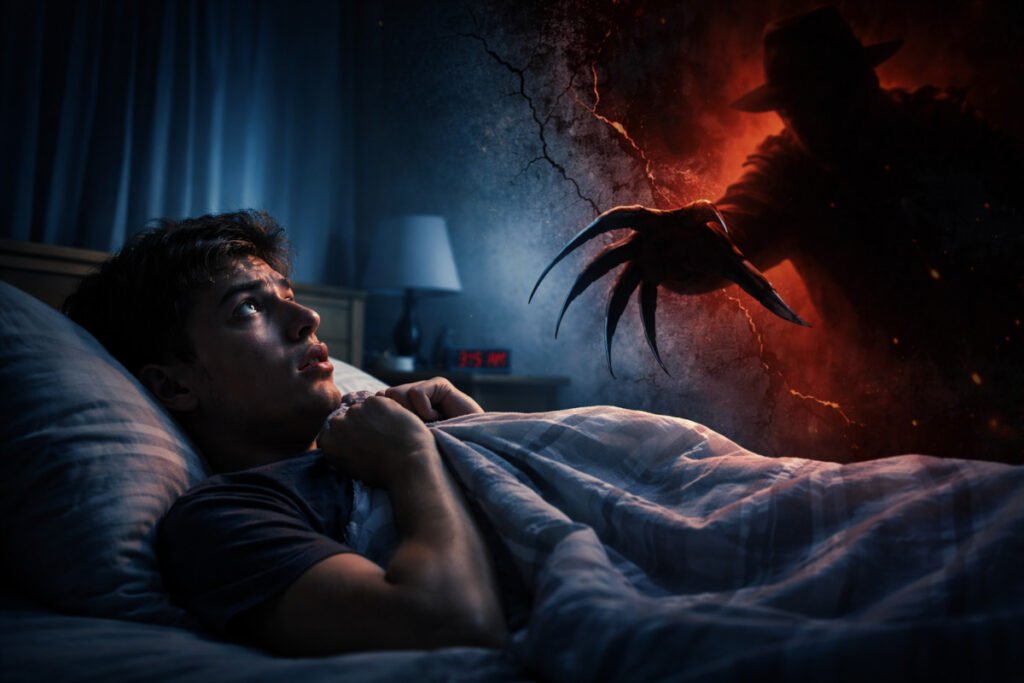
In the film, teenagers are stalked by Freddy Krueger in their dreams. If they die in the dream world, they die in reality. It’s a simple but terrifying premise that mirrors the real-life cases where individuals appeared to be killed by something unseen during sleep.
What makes this even more effective is the universality of sleep. Everyone has to sleep. There’s no escape, no matter how hard you try, an idea directly lifted from the real-life accounts that inspired the film.
The Hat, the Sweater, and the Name
While the concept came from real events, Freddy Krueger’s appearance and identity were shaped by Craven’s own experiences.
The name “Freddy Krueger” was taken from a childhood bully who had tormented Craven at school. The character’s iconic red-and-green striped jumper was chosen because those colours are difficult for the human eye to process together, creating a subtle visual discomfort.
Even Freddy’s fedora and shadowy presence were influenced by a childhood memory of a mysterious man who frightened Craven as a boy, standing outside his window, staring in.
Sleep Paralysis and Night Terrors
Another layer of realism comes from sleep disorders such as sleep paralysis. Many people who experience sleep paralysis report seeing figures in their room, feeling unable to move, and sensing a threatening presence.
These experiences bear a striking resemblance to Freddy’s attacks in the film. The blending of dream and reality, the inability to escape, and the overwhelming sense of dread all contribute to the film’s enduring power.
Why the Film Still Feels So Real
What sets A Nightmare on Elm Street apart from other horror films is how personal the fear feels. You don’t need to visit a haunted house or wander into the woods, the danger comes to you when you close your eyes.
By grounding its supernatural premise in real-world fears and unexplained phenomena, the film taps into something deeply psychological. It exploits the vulnerability we all share when we sleep.
Final Thoughts
The true horror of A Nightmare on Elm Street lies not just in Freddy Krueger, but in the reality that inspired him. The idea that nightmares could have deadly consequences is far more frightening than any slasher stalking the streets.
Even today, the film serves as a reminder that some of the most terrifying stories are rooted in truth. And the next time you have a bad dream, you might find yourself wondering… what if you couldn’t wake up?