The Haunting (1963) Review – A Timeless Psychological Horror Masterpiece
Title:
The Haunting (1963)
Writer(s):
Nelson Gidding, based on the novel The Haunting of Hill House by Shirley Jackson
Director:
Robert Wise
Main Cast: Actor (Character):
Julie Harris (Eleanor “Nell” Lance), Claire Bloom (Theo), Richard Johnson (Dr. John Markway), Russ Tamblyn (Luke Sanderson)
Synopsis
The Haunting (1963) is widely regarded as one of the most effective haunted house films ever made, adapting Shirley Jackson’s The Haunting of Hill House with remarkable restraint and psychological precision. The story follows Dr. John Markway, who invites a small group of individuals with paranormal sensitivities to stay at the infamous Hill House in order to study its supernatural phenomena.
Among them is Eleanor “Nell” Lance, a fragile and lonely woman who has spent years caring for her invalid mother. Upon arriving at Hill House, Nell becomes increasingly unsettled as the house appears to single her out, through eerie noises, unseen forces, and a creeping sense of dread that may be psychological, supernatural, or both.
As tensions rise and fear takes hold, the line between reality and imagination blurs, leading to a haunting exploration of isolation, identity, and the terrifying power of suggestion.
What Works
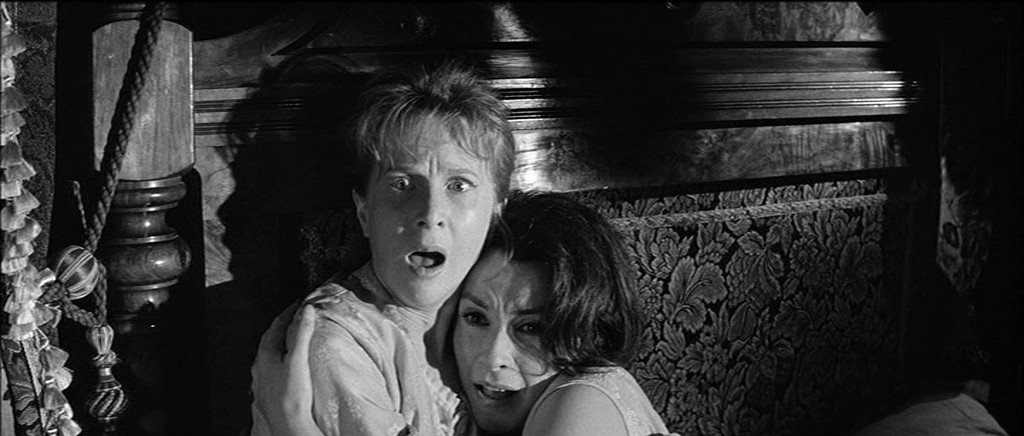
Robert Wise’s direction is masterful in its use of suggestion over spectacle. Rather than relying on visual effects, the film builds terror through sound design, camera angles, and performance. The infamous banging on the walls sequence remains one of the most chilling moments in horror, achieved without ever showing a tangible threat.
Julie Harris delivers an extraordinary performance as Nell. Her portrayal captures vulnerability, longing, and psychological fragility, making her descent into fear both believable and deeply unsettling.
The film’s use of black-and-white cinematography enhances its gothic atmosphere. Deep shadows, warped perspectives, and the oppressive architecture of Hill House create a sense of unease that lingers long after the film ends.
The ambiguity of the horror is perhaps its greatest strength. The film never definitively confirms whether the events are supernatural or manifestations of Nell’s psyche, allowing the audience’s imagination to fill in the gaps.
What Doesn’t Work
For some modern viewers, the film’s slow pacing and lack of explicit scares may feel underwhelming. Its reliance on dialogue and atmosphere over action requires patience and engagement.
Certain performances, particularly from supporting characters, can feel slightly theatrical by contemporary standards, reflecting the era’s acting style.
Additionally, those expecting clear answers or a definitive explanation may find the film’s ambiguity frustrating.
Final Thoughts: Does It Hold Up?
The Haunting (1963) not only holds up, it remains a benchmark for psychological horror and haunted house storytelling. Its emphasis on atmosphere, character, and suggestion has influenced countless films that followed. In an era saturated with visual effects, its restraint feels even more powerful.
It stands as a testament to the idea that what we don’t see is often far more frightening than what we do.
Who Would Enjoy This Episode?
- Fans of classic and psychological horror.
- Viewers who appreciate slow-burn, atmospheric storytelling.
- Admirers of Shirley Jackson’s work.
- Those interested in influential horror cinema history.
Who Might Not Enjoy It?
- Viewers expecting modern pacing or jump scares.
- Audiences who prefer explicit, visual horror.
- Those who dislike ambiguous endings.
Final Verdict
The Haunting (1963) is a masterclass in psychological horror, subtle, intelligent, and deeply unsettling. With its haunting performances, innovative direction, and enduring atmosphere, it remains one of the greatest haunted house films ever made.